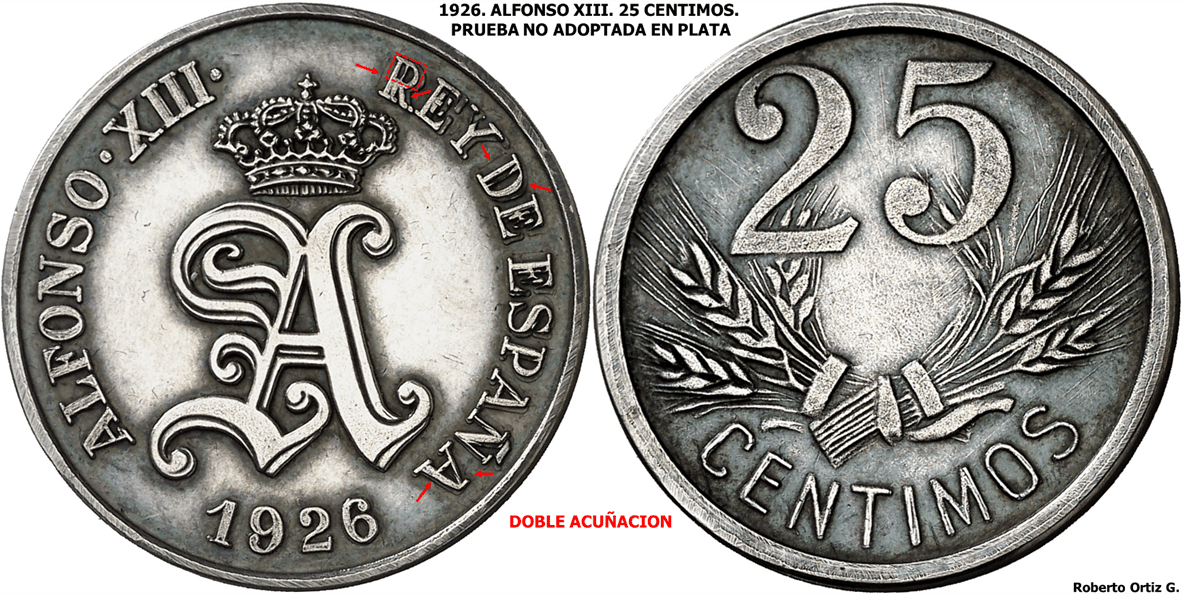
La Doble Acuñación es un error que se produce durante la acuñación del cospel. Es un error de acuñación. Puede afectar a ambas caras de la moneda, a una sola cara, o distintas áreas en tamaño de la moneda,… En los EEUU y de ahí succionan información y términos, muchos numismaticos, han creado en los ultimos años, un termino nuevo, para cuando este error de acuñación, afecta a una sola cara de la moneda. Ellos lo denominan Duplicado de Maquina.
Expongo a continuación un enlace de un numismatico Estadounidense, que me parece interesante, y con el cual, estoy de acuerdo. Bastante complicado, es entender a veces ciertos detalles de las monedas, y mucho mas para los que se inician, como para complicarlo mas, con nuevos términos. Pero mejor lo explica el Numismatico Americano a continuación.
https://conecaonline.org/wp-content/uploads/2017/10/StrikeDoublingFlyer-1.pdf
Strike Doubling
Strike doubling is the most often confused type of doubling and very often mis-identified as a doubled die or RPM. Not only do novices confuse this type of doubling
with doubled dies, but specialists even disagree as to whatthe correct terminology should be.
The term “strike doubling” is what I prefer and what I feel most accurately reflects the cause. Strike doubling is caused during the striking process. If one of the dies is loose as they come together to strike the coin, the loose die will twist slightly immediately as the hammer die starts to retract.
Some will argue that the striking of the coin ends when the hammer die reaches the very end of its stroke. Thus, this should not be called “strike doubling” by their terms,
but rather mechanical or machine doubling. In my opinion, this is like trying to split a hair. Additionally, I feel that “Machine” or “Mechanical” doubling can be even more
confusing, as neither term indicates in which part of the minting process this happens. Either of those terms could refer to the coin counters at the end of the process! I feel
“strike doubling” is best suited to describe the point of the minting process in which this doubling occurs.
Secondly, we all agree there are three basic areas of the minting process planchet, die, and striking. This doubling occurs during the striking process, and not in the die making or planchet making process. We don’t refer to incomplete planchets as a machine problem, although it was caused by a machine, but rather an incomplete planchet.
During my tours of the U. S. Mints in Philadelphia and Denver in 1994, and in Denver twice in 1996, the personnel in both facilities confirmed the cause. Additionally, they
stated that when they do encounter this doubling, they would tighten the dies into their holding collars, and the doubling would cease.
Whether you refer to this as “strike,” “machine,” “mechanical,” or “ejection” doubling, the primary focus should be to understand the difference and educate others.
As a rule, strike doubling will exhibit a flat, shelf-like secondary image, contrary to the rounded secondary images of true die doubling. This secondary image will also usually
be low to the field. There will be no splits in the serifs. On most uncirculated and proof coins, strike doubling will give the appearance that the metal has been “moved,” much
like that on hobo nickels or love tokens, and will have a very shiny appearance.
Strike doubling can affect all lettering on one or both sides, or could be detected on only one letter or a small portion of a device. Proof coins often exhibit strike doubling due to the excessive force employed. Strike doubling can be evident on a coin with a true doubled die or true RPM.
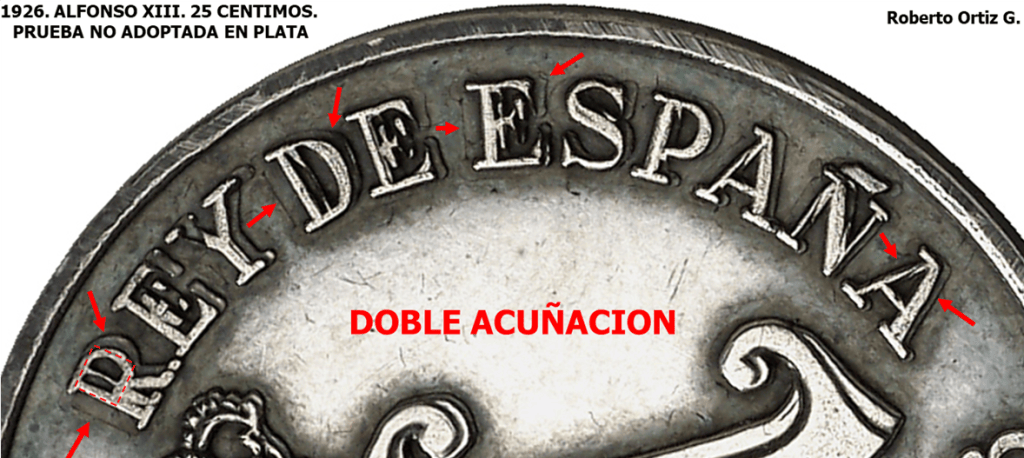
La siguiente pieza, presenta una Doble Acuñación en el Anverso. Los trazos rojos, señalan algunos de los detalles característicos de la Doble Acuñación. La pieza fue acuñada a Volante con Virola (Listel).
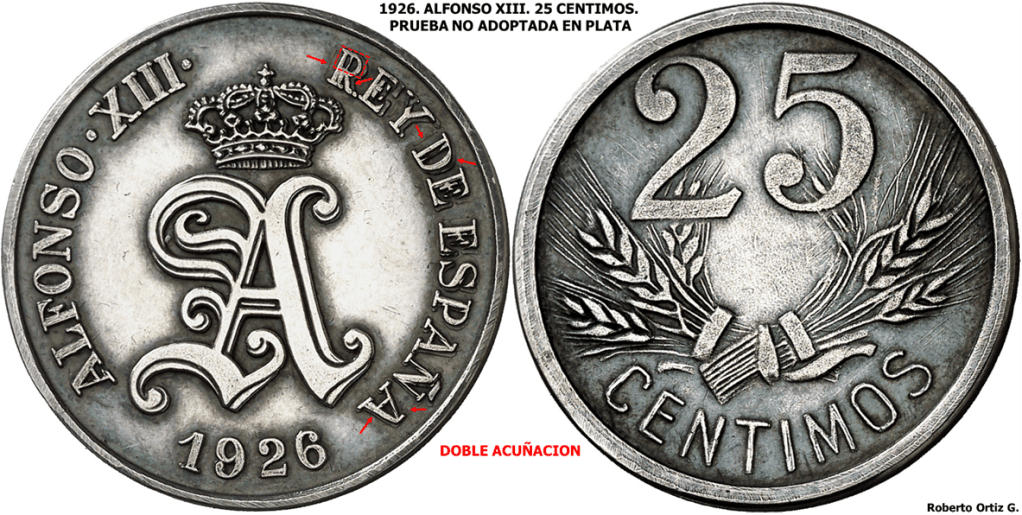
1926. Alfonso XIII. 25 céntimos. (AC. 25, mismo ejemplar). Prueba no adoptada en plata. Bella. Rarísima, sólo hemos tenido esta. 7,91 gr. S/C-. Ex Colección General Prim 16/12/2021, nº 164.
Hay numismaticos o coleccionistas que niegan el termino o error, Doble Acuñación cuando afecta a una sola cara de la moneda. En el anterior enlace del numismatico Estadounidense, reconoce la Doble Acuñación en una sola cara.
La Doble Acuñación es muy puñetera en comportamiento. Solo hay que ver monedas pasa darse cuenta de ello. Como se ha dicho, puede afectar a diferentes áreas en tamaño. Pero lo importante no es saber cómo ha ocurrido, sino distinguirla. ¿Como distingues un error?. Comparando con otros similares. Creo así lo hacen todos. Mismos detalles en piezas diferentes, en principio, mismo error. Independientemente de que afecte a una o dos caras, los detalles consecuencia del error, presentan similitud.
Saber que puede ocurrir, que es factible el error en la Ceca, y algunas de sus causas, si, es para tenerlo en cuenta, por el tema de las falsificaciones, manipulaciones,… Pero bastantes veces no podemos aseverar la causa exacta del error. No solo puede bailar un troquel, también el cospel puede hacerlo, o ambos, también puede ocurrir…la velocidad a la que se acuña es tremenda. Lo importante es saber reconocer el error y ahí los detalles de la moneda son los que hay que leer. ¿No debería ser así?.
Tres tecnicas de acuñacion distintas – Mismos detalles (Aplanamiento y Doble Agujero)
DOBLE ACUÑACION EN TRES TECNICAS DE ACUÑACION DISTINTAS
¿Mismos detalles en tres distintas técnicas de acuñación, no nos lleva a pensar en mismo error?. Las tres técnicas coinciden en un punto. Golpe. Acuñación por Percusión. ¿Se puede utilizar el termino Doble Acuñación para las tres técnicas?
En la técnica de Acuñación a martillo no hay maquina, es un proceso humano, manual,… En la técnica de Acuñación a Volante sin virola, piezas de Felipe V, Fernando VI, Carlos III, Carlos IV, Fernando VI y algunas de Isabel I, las maquinas funcionaban bien con animales, bien con fuerza humana….
8 ESCUDOS 1705 FELIPE V. SEVILLA. DOBLE ACUÑACION.
¿Es incorrecto emplear el Termino Doble Acuñación, cuando el error afecta solo a una cara de la moneda?. ¿Hay que emplear otro termino?. ¿No son los Detalles del error los que nos ayudan a reconocer el error y con ello, el tipo de error?.
 LEYENDO MONEDAS/NUMISMATICA